Conspiracy – “The event was staged by powerful people”
Fact : No, it wasn’t staged.
- No credible evidence supports staging
- Multiple independent confirmations exist
- Real suspect and real response occurred

This theory is rooted in a psychological tendency called proportionality bias, where people believe that big events must have equally big causes. When something dramatic happens—especially involving political figures—many assume it cannot be random or individual-driven. Instead, they imagine a coordinated plan by powerful entities.However, staging an event of this scale would require an extraordinary level of secrecy and coordination. Think about the number of people involved: security teams, law enforcement, medical responders, event staff, journalists, and attendees. For the conspiracy to hold, all of these individuals would need to either participate or remain silent indefinitely. In reality, large conspiracies almost always collapse because information leaks—people talk, documents surface, and inconsistencies appear.Additionally, modern investigations involve multiple independent bodies, making it even harder to hide fabricated events. What often happens instead is that real incidents are later used in political debates or policy discussions, which can create the illusion that they were planned. But using an event is not the same as creating it. The simpler and more realistic explanation is that this was a genuine incident, not a staged operation.
Conspiracy – “Security let it happen (inside job)”
Fact : No confirmed insider involvement.
- No proof of intentional security failure
- Breaches can occur even in strong systems

This theory comes from the assumption that high-security environments are flawless. People think that if something goes wrong, it must be intentional. But in reality, no system—no matter how advanced—is perfect. Security systems are designed to reduce risk, not eliminate it completely.Experts often describe failures using the “Swiss cheese model.” Imagine multiple layers of protection, each with small holes or weaknesses. Normally, these holes don’t align. But in rare cases, they line up briefly, allowing a breach to occur. This doesn’t mean anyone deliberately caused it—it simply means that multiple small imperfections coincided at the same time.Human factors also play a major role. Security personnel work long hours under pressure, and even highly trained individuals can make mistakes. Additionally, attackers often exploit unpredictability, choosing moments or methods that bypass standard expectations.The idea of an “inside job” feels convincing because it provides a clear, intentional cause. However, real-world systems are messy and imperfect. Failures are usually the result of complex interactions between human error, timing, and system limitations, not secret collaboration. It’s less dramatic, but far more realistic.
Conspiracy – “The attacker was mind-controlled”
Fact : No evidence of mind control.
- No modern proof of such programs
- Most attackers act independently
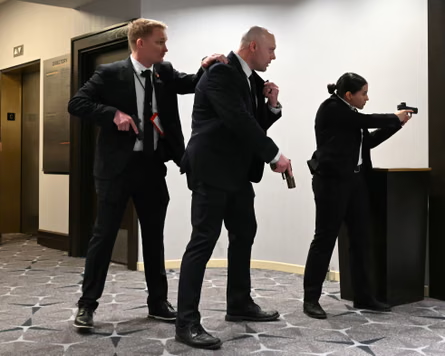
The mind-control theory is heavily influenced by historical programs like MK-Ultra, which experimented with psychological manipulation decades ago. Because such programs once existed, some people assume similar techniques are still being used secretly today. This creates a bridge between real history and modern speculation.However, there is no credible evidence that advanced mind-control techniques capable of directing complex actions exist today. Human behavior, while sometimes unpredictable, can usually be explained through well-understood psychological and social factors. Many attackers are influenced by a combination of personal grievances, ideological beliefs, emotional distress, and environmental factors.When someone commits an extreme act, it can feel difficult to accept that they did so on their own. The idea of mind control provides a more structured explanation, making the situation feel less random. But this is a cognitive shortcut—it replaces complexity with a simplified, dramatic narrative.In reality, humans are capable of making extreme decisions without external control. Social isolation, exposure to certain ideas, and emotional instability can all contribute to such behavior. While the theory is intriguing, it overlooks the powerful role of individual psychology and lived experience, which are far more consistent with real-world evidence.
Conspiracy – “It was done to distract the public”
Fact : No proof of planned distraction.
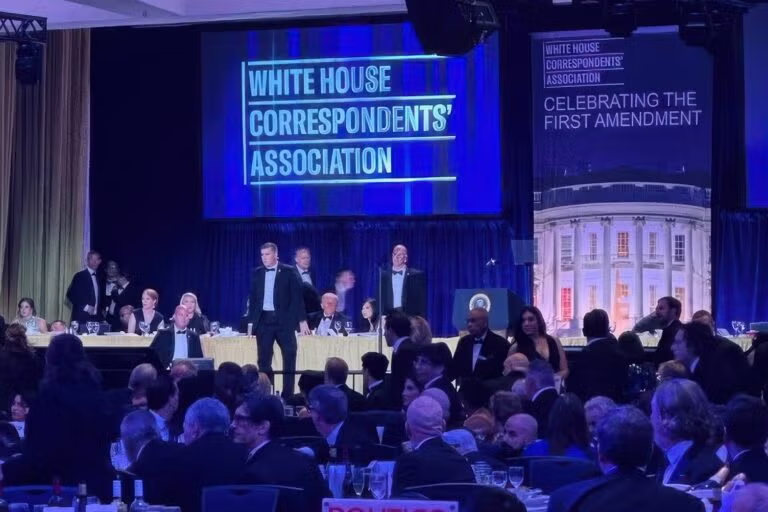
This theory arises from how people interpret media behavior. When a major event occurs, it quickly dominates headlines, pushing other stories out of focus. This shift can make it seem like the event was designed to distract from something else. However, this is usually a misunderstanding of how news prioritization works.Media organizations operate based on urgency and audience interest. When something dramatic happens—especially involving public safety or political figures—it naturally becomes the top story. This is driven by attention economics, where the most immediate and impactful events receive the most coverage.Humans also tend to look for hidden patterns. If another issue was being discussed before the incident, and suddenly disappears from headlines, it’s easy to assume intentional distraction. But in reality, this is simply how information cycles function.There is also a bias known as confirmation bias, where people focus on information that supports their existing suspicions. If someone already distrusts institutions, they are more likely to interpret normal media behavior as manipulation.In most cases, the simpler explanation is correct:
A significant event occurred, and attention shifted naturally.
Not because it was planned—but because it was important.
Conspiracy – “Foreign powers were behind it”
Fact : No confirmed foreign involvement.
- No evidence linking the attacker to another country

The idea of foreign involvement is influenced by real-world geopolitical tensions. Countries do engage in interference, but it typically occurs through cyber operations, misinformation campaigns, or economic pressure, rather than direct violent attacks on high-profile domestic events.Direct involvement in such an incident would carry enormous risks. If proven, it could lead to severe diplomatic consequences or even military escalation. Because of this, governments tend to avoid actions that could be easily traced back to them.This theory also reflects a broader tendency to attribute complex events to powerful external forces. It can feel more logical to assume that a government-level actor is behind a major incident, rather than accepting that an individual acted alone. However, this assumption doesn’t align with how modern international strategy usually works.Investigations into such incidents are thorough and involve intelligence agencies that specifically look for foreign connections. The absence of confirmed evidence strongly suggests that this was not the case.While the theory may seem plausible on the surface, it overlooks the strategic risks and practical realities of international relations. Most evidence points toward individual or domestic factors rather than coordinated foreign involvement.
Conspiracy – “Media is hiding the real truth”
Fact : No evidence of a coordinated cover-up.
- Core facts are consistent across major sources
- Differences are mostly due to timing and updates

This theory is driven by a common misunderstanding of how news develops in real time. When an incident first occurs, information is often incomplete, and early reports may contain errors or missing details. As more verified data becomes available, journalists update their stories. To some people, these changes appear suspicious, as if the narrative is being altered intentionally.In reality, this process is a normal part of breaking news reporting. Journalists rely on sources that may initially provide partial or conflicting information. Over time, facts are confirmed, corrected, or expanded. What looks like inconsistency is often just information becoming more accurate.Another factor is media bias perception. People tend to distrust sources that don’t align with their beliefs, interpreting any variation as manipulation. Social media amplifies this by highlighting contradictions without context, making normal updates seem like deliberate cover-ups.A true coordinated media conspiracy would require multiple independent organizations to align perfectly, which is highly unlikely given competition between outlets. The simpler explanation is that news evolves as facts are verified, not that the truth is being hidden.
Conspiracy – “The attacker didn’t act alone”
Fact : No confirmed evidence of accomplices.
- Investigations have not proven coordinated support
- Many attacks are carried out individually

This theory comes from the difficulty people have in accepting that a single individual can carry out a high-impact act. When something major happens, it feels intuitive to assume a network or group must be behind it. This is linked to a psychological tendency where people associate scale of impact with scale of planning.However, history shows that many serious incidents are carried out by individuals acting alone. With access to information, tools, and planning resources, a single person can prepare extensively over time. The digital age has made it easier for individuals to research, plan, and execute actions without direct support.The “not acting alone” idea also provides a sense of order. It replaces uncertainty with a structured narrative involving hidden groups. But investigations typically analyze communication records, financial activity, and digital footprints. If accomplices were involved, evidence usually surfaces.In most cases, the absence of such evidence indicates that the individual acted independently. While it may feel unsettling, the reality is that one motivated person can have a significant impact, and this explanation aligns more closely with known patterns of behavior than the idea of a hidden network.
Conspiracy – “The suspect is a scapegoat”
Fact : No proof the suspect is falsely blamed.
- Evidence ties the suspect directly to the incident
- Legal processes involve verification and scrutiny

This theory suggests that authorities have blamed the wrong person to quickly close the case or hide the real perpetrators. It often arises when people distrust institutions or believe that the “real story” is being concealed.In reality, criminal investigations involve multiple layers of verification. Evidence is collected from various sources, including surveillance footage, forensic analysis, witness statements, and digital records. This information is reviewed not just by law enforcement, but also by legal teams, courts, and sometimes independent investigators.The idea of a scapegoat assumes that all these systems would fail simultaneously or cooperate in deception. While errors can occur in isolated cases, large-scale false framing is extremely difficult to maintain without contradictions emerging over time.Additionally, high-profile cases receive intense public and media scrutiny. Journalists, legal experts, and independent observers often examine the evidence closely. If inconsistencies existed, they would likely be exposed.This theory persists because it offers a dramatic alternative to the official explanation. However, the combination of evidence-based investigation and legal oversight makes it far more likely that the identified suspect is genuinely responsible.
Conspiracy – “It was planned months in advance by hidden elites”
Fact : No evidence of elite coordination.
- No proof of long-term orchestration by powerful groups
This theory is based on the belief that major events are rarely spontaneous and must be part of a long-term plan by influential individuals or organizations. It reflects a broader worldview where powerful elites are seen as controlling significant global or national events behind the scenes.While planning does occur in many areas—politics, business, and strategy—there is no evidence that such groups orchestrate incidents like this. Coordinating an event over months would require secrecy across multiple domains, including logistics, personnel, and communication. The more complex the plan, the harder it is to keep hidden.Humans also tend to overestimate the level of control that powerful groups have. In reality, even highly organized institutions struggle with unpredictability and internal disagreements. Maintaining a perfectly executed secret plan involving violence would be extremely difficult.This theory is appealing because it provides a sense of structure and intention, replacing randomness with control. However, most real-world events are influenced by a combination of individual actions, situational factors, and chance, rather than long-term hidden orchestration.
Conspiracy – “The event was predicted, so it must be planned”
Fact : Predictions do not equal planning.
- No evidence that prior speculation proves coordination
This theory often emerges when people find posts, comments, or discussions that seem to “predict” an event before it happens. These are then interpreted as proof that the incident was pre-planned or that certain individuals had prior knowledge.However, in a world with millions of people sharing ideas online, it is statistically likely that someone will make a prediction that appears accurate in hindsight. This is known as retrospective pattern recognition—we notice the hits and ignore the countless misses.People frequently speculate about potential risks, especially around high-profile events. When one of these predictions aligns with reality, it stands out, creating the illusion of foresight or insider knowledge. In truth, it is often coincidence rather than evidence.Another factor is selective attention. People search for information that supports the idea of prediction while overlooking the broader context. This reinforces the belief that the event was planned.In most cases, what appears to be prediction is simply the result of probability, coincidence, and human pattern-seeking behavior, rather than proof of intentional planning.
